15: The Crystal Gets a Past
At the end of the last chapter, our Digital Crystal could tell us something about the world that formed it.
But not enough.
Different forcing processes produced different morphologies.
We could hide the source and recover its family substantially better than chance.
Then we asked a harder question:
What happened first?
We took exactly the same environmental values and rearranged them in time.
Smooth.
Bursting.
Periodic.
Alternating.
Random.
The final morphology could not reliably tell them apart.
SAME VALUES
+
DIFFERENT ORDER
↓
NO RECOVERABLE TEMPORAL SIGNATURE
The crystal had accumulated a state.
It had not preserved a usable history.
That gives us the next experiment.
Not intelligence.
Not learning.
Not adaptation.
Something much smaller.
What must a digital process preserve if we want its past to survive?
The Present Is Not the Past
Our Digital Crystal already has a present state.
At any moment, (C_t) contains the cells that currently exist.
Those cells are consequences of earlier growth.
So the past clearly mattered.
But Chapter 14 taught us an important distinction:
Past contributed to present does not imply present contains a recoverable record of the past.
A footprint exists because someone walked there.
The footprint is not the walk.
A crater exists because something struck the ground.
The crater is not the complete trajectory of the object that made it.
Our crystal is similar.
Its current shape contains consequences.
That does not mean it contains the sequence that produced them.
So we need to separate two ideas:
STATE
and
HISTORY
State
We begin with an operational definition:
A state representation is sufficient if it contains enough information to continue the process faithfully from here.
That wording matters.
We are not claiming that we already know the mathematically smallest possible state.
We are asking whether a particular stored representation is sufficient.
Perhaps the picture itself is enough.
Perhaps:
occupied cells
is the complete state.
We can test that.
Digital Crystal v1 is stochastic.
Its continuation depends on random attachment decisions.
Its continuation also depends on where the process currently is in the environmental input.
So a candidate checkpoint might contain:
occupied cells
birth-time metadata
current timestep
current signal position
random-number-generator state
model parameters
But we should not declare all of those necessary merely because they sound plausible.
We should remove them.
One at a time.
Run the Crystal Continuously
We take frozen Digital Crystal v1 from Chapter 14.
The local growth rule does not change.
The experiment runs for:
96 steps
with a checkpoint halfway through:
t = 48
In the full v3 experiment:
population at checkpoint    2,702
final population            9,574
The final morphology receives a hash:
bc8e6d8c9783431f1459bf17
and the full process state receives another:
bd33c9aa0a510803be6ce6bf
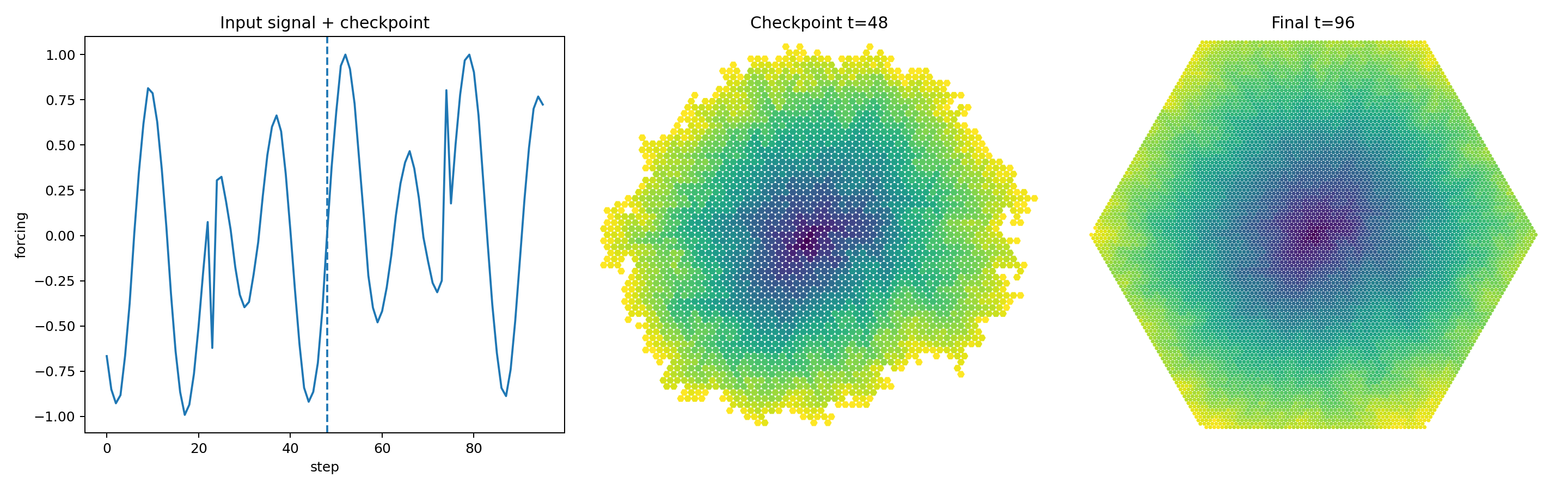
The continuous reference trajectory. The midpoint checkpoint will be restored, damaged and replayed in later experiments.
Now we can demand something much stronger than visual similarity.
If the checkpoint is sufficient, then restoring it should produce:
exactly the same future.
Before We Could Save the State, We Found a Hidden One
Our first implementation failed this experiment.
The checkpoint appeared complete.
We saved:
occupied cells
birth metadata
timestep
signal cursor
RNG state
Then we restored it.
The future changed.
At first that looked like evidence that something important was missing from our checkpoint.
But another result contradicted that interpretation.
When we reconstructed the same checkpoint without passing through serialization, continuation was exact.
So something was happening at the implementation boundary.
The culprit was surprisingly mundane.
Candidate attachment sites were held in a Python set.
The growth loop effectively did:
for cell in frontier:
    ...
    rng.random()
A set has no scientific ordering.
Its internal iteration order is an implementation detail.
Two sets can contain exactly the same cells but iterate them in different orders after reconstruction.
That meant:
same mathematical cells
+
same RNG state
+
same signal
could still become:
RNG draw #1 → different candidate
RNG draw #2 → different candidate
...
The simulation had accidentally acquired an undeclared state variable:
PYTHON CONTAINER LAYOUT
That is not a property of the Digital Crystal.
It is a property of the implementation.
So we removed it.
The growth rule now consumes stochastic decisions in a canonical order:
for cell in sorted(frontier):
Then we reran the experiment.
State Belonging to the Model vs State Belonging to the Program
Before trusting checkpointing again, we added a stronger invariant.
Take a checkpoint.
Serialize and deserialize:
occupied cells
birth metadata
RNG state
into fresh Python objects.
Then compare the original state and reconstructed state.
They must produce:
same one-step continuation
and
same complete remaining continuation
The v3 reproducibility invariant passed:
occupied state equal                   True
birth metadata equal                   True
signal cursor equal                    True
RNG state equal                        True
process hash equal                     True

one-step continuation exact            True
full remaining horizon exact           True
remaining steps checked                48
The implementation no longer depends on accidental set layout.
That gives us a methodological rule worth keeping:
An experimental model must distinguish state belonging to the phenomenon from state accidentally belonging to its implementation.
Only after that did checkpointing become a meaningful experiment.
Stop It
At step 48 we serialize the operating state.
Not a screenshot.
Not a rendered image.
The actual continuation representation.
Then we terminate that runtime state.
Load the checkpoint from SQLite.
Continue.
If our checkpoint representation is sufficient, the restored process should not merely resemble the uninterrupted one.
It should become:
the same cells
the same attachment decisions
the same population trajectory
the same final process state
Save, Restore, Continue
After the reproducibility fix:
exact final morphology            True
exact final process state         True
population trajectory identical   True
attachment trajectory identical   True
symmetric-difference cells        0
The morphology hashes match:
REFERENCE   bc8e6d8c9783431f1459bf17
RESTORED    bc8e6d8c9783431f1459bf17
The complete process hashes match too.
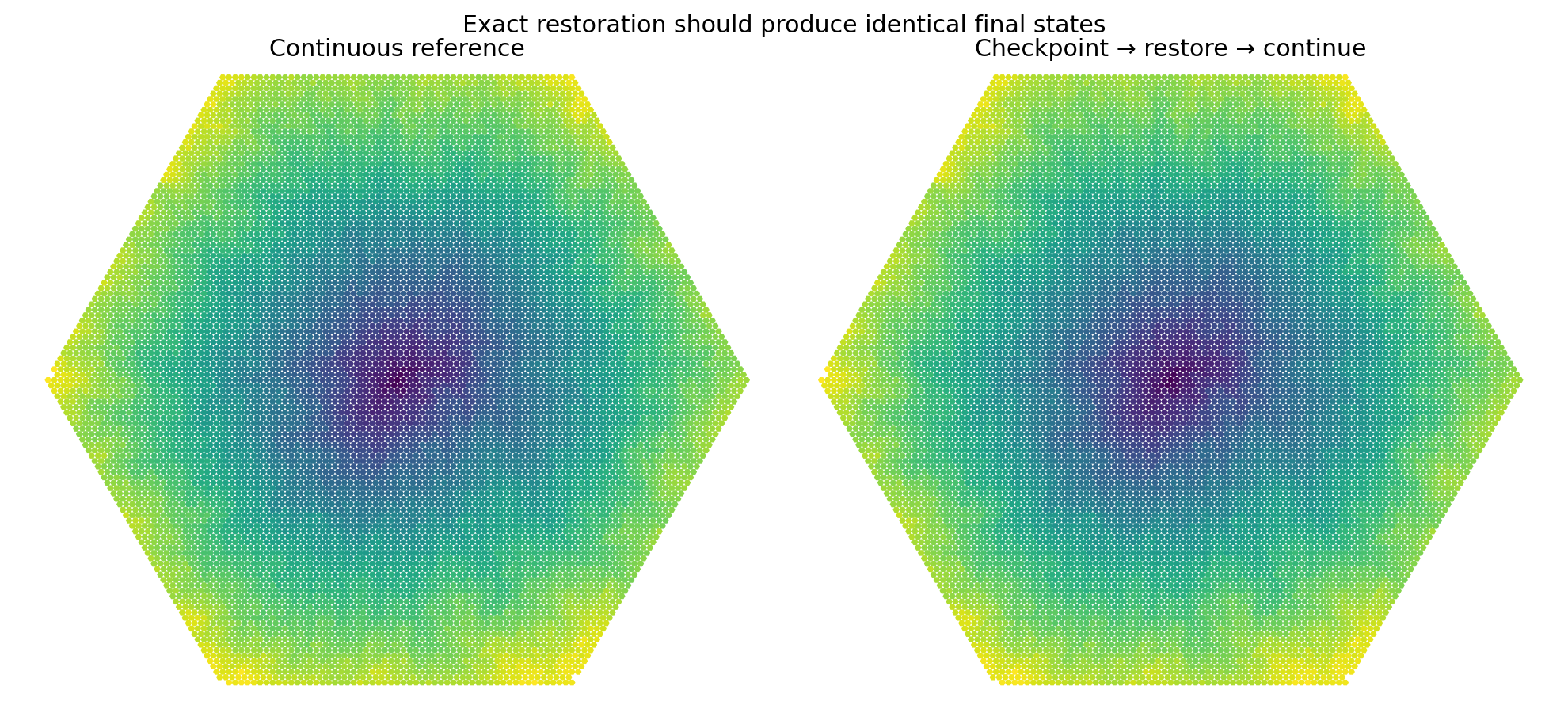
After canonicalizing stochastic candidate traversal, continuous execution and checkpoint → restore → continue produce the exact same trajectory.
And this was not a one-run accident.
We repeated the checkpoint experiment across:
30 independent runs
Result:
30 / 30 exact
So we have earned the first major claim:
The stored Digital Crystal checkpoint representation is sufficient for exact continuation of the stochastic process.
Notice what we have not claimed.
We have not proven that this is the smallest possible state representation.
That question remains open.
What Actually Matters for Continuation?
Now we deliberately damage the checkpoint.
But this time the experiments are carefully isolated.
Every variant receives exactly:
48 continuation updates
So altering the environmental cursor does not accidentally alter the length of the experiment.
Remove the Random State
First:
same morphology
same birth metadata
same timestep
same signal position
different RNG continuation state
The final result becomes:
final population                 9,550
symmetric-difference cells          28
normalized difference          0.002924
The difference is small.
But it is not zero.
Exact continuation fails.
So:
RNG continuation state matters for exact continuation of Digital Crystal v1.
That is not philosophical speculation.
We removed it.
The future changed.
Move the Environmental Cursor
Next:
same morphology
same RNG state
same timestep
same continuation horizon
but move the signal cursor:
48 → 45
Both conditions still execute exactly 48 future updates.
The result:
final population                 9,549
symmetric-difference cells          27
normalized difference          0.002820
So we can now say:
Where the process currently sits in the environmental sequence affects exact continuation.
The environment is not merely historical context.
Its current position is part of the continuation conditions.
Remove the Birth Times
Now we perform a cleaner test.
Preserve:
occupied cells
RNG state
signal cursor
timestep
but replace the birth-time metadata.
What happens?
final population                 9,574
symmetric-difference cells           0
normalized difference          0.000000
The final occupied set is exact.
Only the birth-time metadata differs.
That gives us an extremely useful distinction.
Under the current Digital Crystal v1 growth rule:
Birth times are part of the historical record, but they are not required for the same geometric continuation.
This is the first place where state and history begin to separate experimentally.
Birth time tells us:
how the current structure formed
but the growth mechanism does not consult it when deciding the next attachment.
So birth time can matter to history without mattering to future growth.
Save Only the Morphology
Now perform the brutal test.
Preserve only the visible occupied structure.
Reconstruct other process details incorrectly.
Continue.
The result:
final population                 9,548
symmetric-difference cells          30
normalized difference          0.003133
The visible shape at the checkpoint was identical.
The future was not.
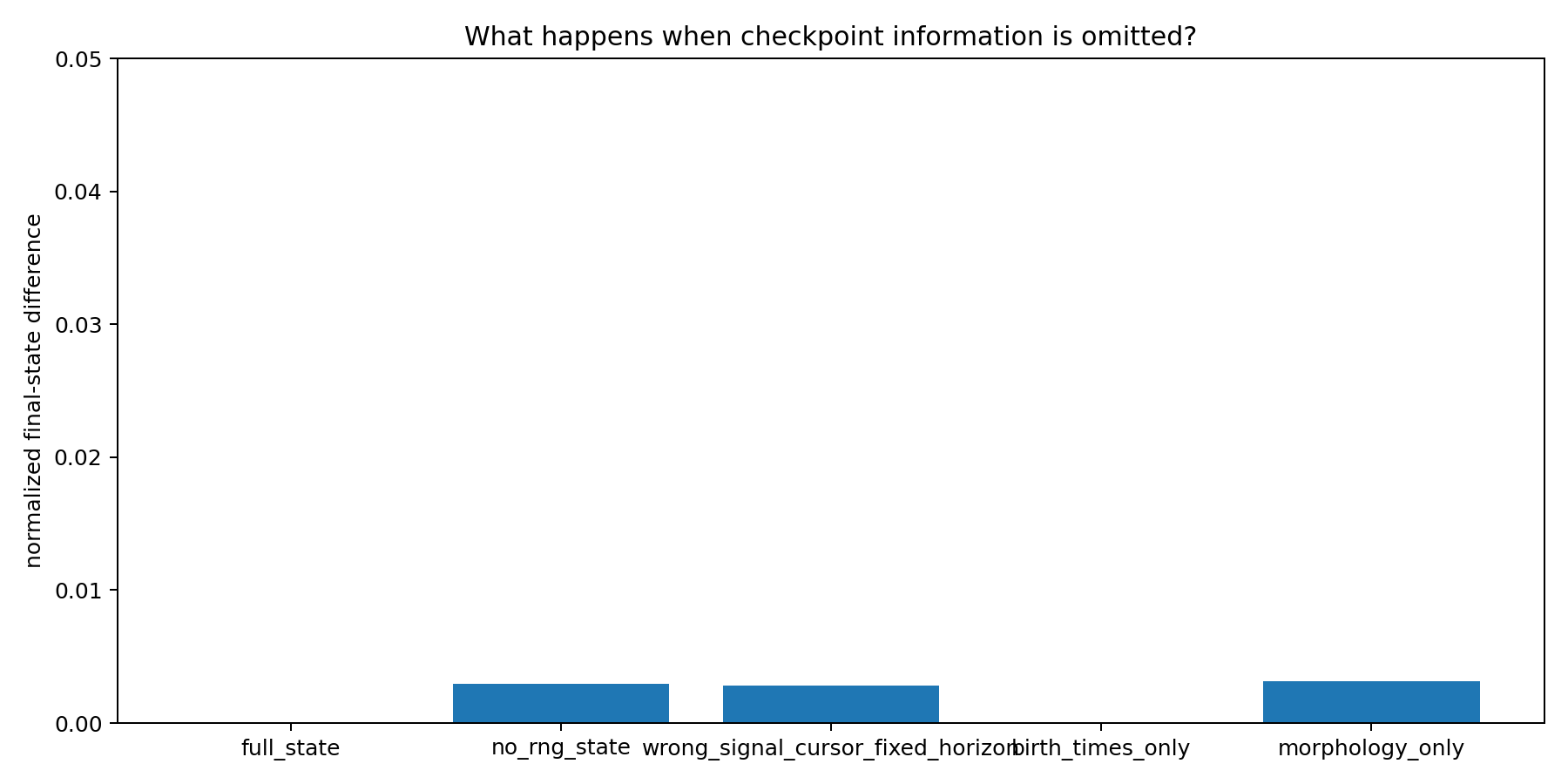
Visible morphology is insufficient for exact continuation. RNG state and environmental sequence position affect future growth, while birth-time metadata does not affect the occupied-set continuation under Digital Crystal v1.
This gives us another version of a lesson that has followed us through the book:
Appearance is not state.
Two systems can look identical and still have different futures.
What We Have Actually Identified
We need to be careful here.
We have not discovered:
the unique minimal state of Digital Crystal v1.
We have discovered something narrower.
The experiments establish:
FULL CHECKPOINT
→ sufficient

VISIBLE MORPHOLOGY ALONE
→ insufficient

RNG CONTINUATION STATE
→ causally relevant to exact continuation

SIGNAL POSITION
→ causally relevant to exact continuation

BIRTH-TIME METADATA
→ not required for geometric continuation
That is enough.
The useful operational idea is:
State is whatever information the future actually needs.
Not whatever information happens to exist in our data structures.
And not whatever information sounds philosophically important.
Now Give It History
Checkpointing solves one problem:
Where are we now, and what do we need to continue?
It does not answer:
How did we get here?
For that, we create an explicit event history.
At every growth step we preserve:
step
input value
cells added
population
resulting morphology hash
So the history becomes:
STEP 1
input = ...
added = [...]
state hash = ...

STEP 2
input = ...
added = [...]
state hash = ...

STEP 3
...
This is not memory in any cognitive sense.
The crystal does not inspect this record.
It does not learn from it.
It does not use it to make decisions.
It is an explicit formation history.
Now we ask whether the record is sufficient to reconstruct what happened.
Replay the Process
There are two different ways to replay a past.
The distinction matters.
Procedural Replay
First:
same initial seed
+
same environmental signal
+
same frozen growth rule
+
same stochastic initialization
↓
run again
The result:
exact final morphology     True
exact final process state  True
That establishes reproducibility of the computational procedure.
But it does not yet establish that the stored event history is sufficient.
So we perform a stronger test.
Replay the Events
This time we do not rerun the stochastic growth rule.
Instead, take the recorded event stream.
At every step:
read cells that appeared
↓
apply those additions
↓
recompute morphology hash
↓
compare with original recorded hash
There are:
96 recorded steps
Result:
96 / 96 morphology hashes match
Final morphology:
exact
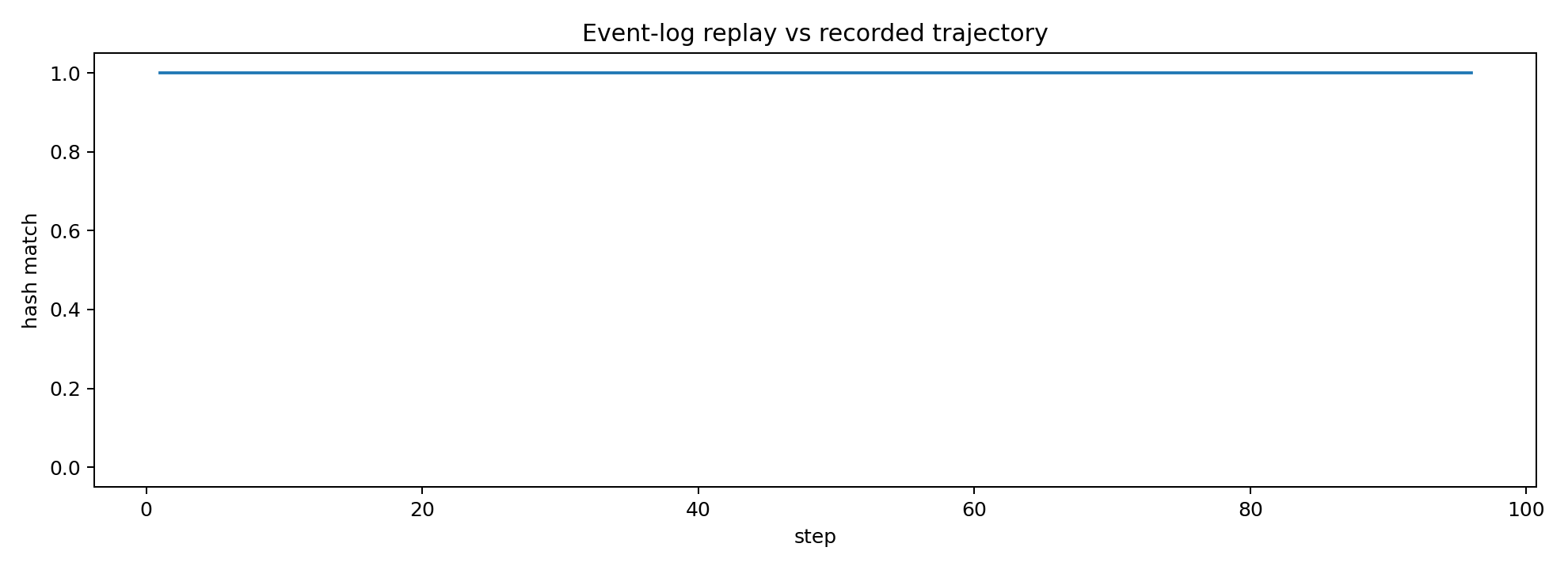
The event history reconstructs the recorded morphology trajectory exactly: 96 matching hashes out of 96.
Now we have earned a second claim:
The explicit event history is sufficient to reconstruct the exact recorded morphology trajectory.
Not the hidden historical RNG state.
Not every internal implementation detail.
The formation trajectory.
That is the correct scope.
State Is Not History
We can now make the distinction operational.
A checkpoint and an event history both describe the same process.
But they answer different questions.
STATE
=
enough information for faithful continuation

HISTORY
=
enough information to reconstruct how the present morphology was formed
A checkpoint can continue forward exactly.
An event log can reconstruct backward through the morphology trajectory.
But those capabilities are not interchangeable.
The history reconstructed from cell additions does not restore the historical RNG state.
And if we take reconstructed geometry without the correct stochastic continuation state, exact future continuation fails.
In the full experiment:
history reconstructs checkpoint morphology    True
checkpoint continues exactly                  True

history-derived geometry without RNG
continues exactly                             False
The final difference in that last condition was:
0.003133
So:
CHECKPOINT
→ FUTURE

EVENT HISTORY
→ PAST MORPHOLOGY
They overlap.
But they are different mechanisms.
The Digital Answer Was Not Biological
There is something important about how we solved this.
We could have tried to build a special region inside the crystal whose geometry somehow encoded its entire formation history.
A biological analogy might tempt us toward:
memory organ
genome-like store
special history structure
But computation gives us another possibility.
serialization
checkpoint
event log
replay
branch
These are native computational affordances.
We do not need to imitate a biological storage mechanism if the substrate gives us a different way to preserve the same capability.
This is exactly the rule we established earlier:
Do not import a biological mechanism unless the digital substrate actually requires it.
The crystal’s past does not need to look biological.
It only needs to be recoverable.
A Digital Advantage
Biological systems generally do not offer us cheap, exact, executable copies of an earlier complete physical state.
Digital systems often can.
Our checkpoint is executable.
That changes what a saved past can be.
It is not merely evidence that something happened.
It can become:
an experimental starting point
from which alternative futures are generated.
Restore the Same Past Twice
Take the exact checkpoint at step 48.
Restore it twice.
Both copies begin with:
same occupied cells
same timestep
same signal cursor
same RNG state
same continuation state
Nothing differs.
Then deliberately provide different future environments.
              ┌── FUTURE A
SAVED PAST ───┤
              └── FUTURE B
The resulting morphologies diverge.
In one illustrative branch:
final symmetric difference    35 cells
normalized difference         0.003655
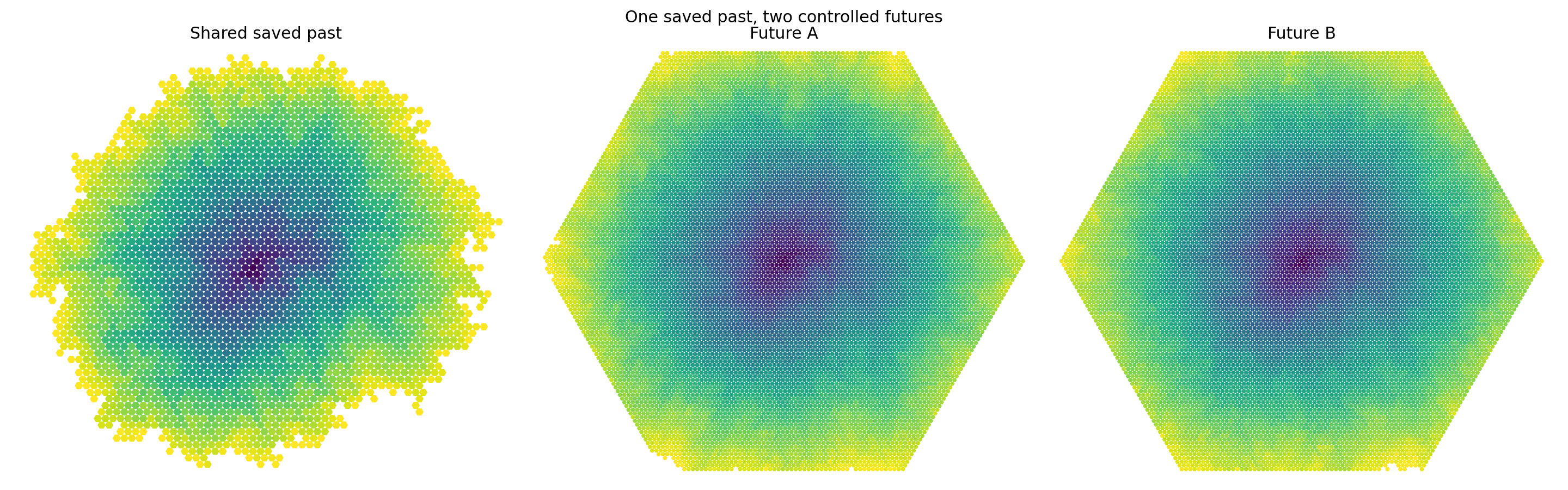
One exact checkpoint serves as a shared executable starting condition for two controlled future environments.
And we can watch that divergence develop.
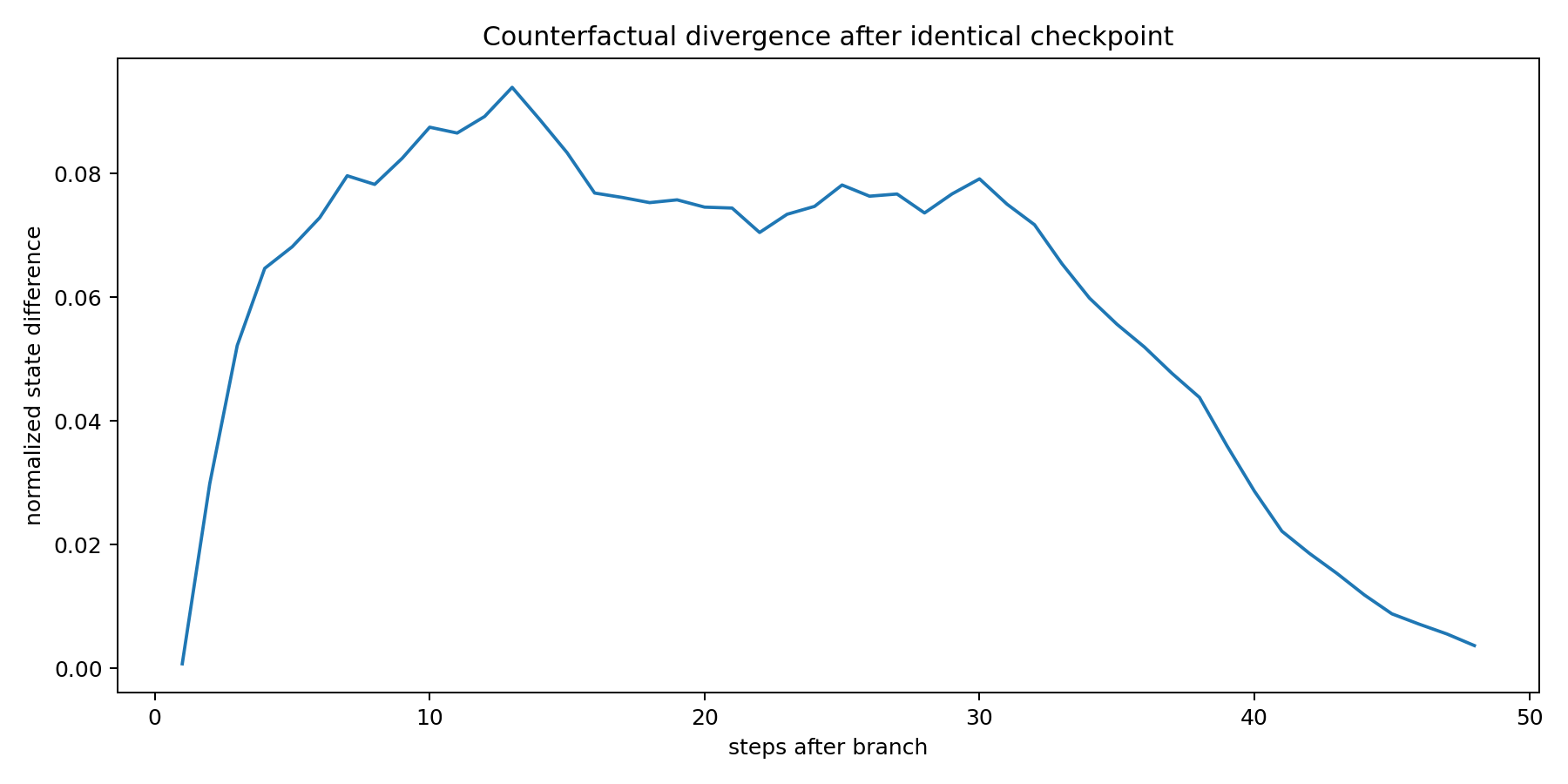
Alternative prescribed futures starting from the same saved state generate measurable divergence.
So one capability is clearly established:
A complete digital checkpoint can act as an executable counterfactual branch point.
But there is a trap here.
Different Futures Always Diverge — But Why?
Suppose two continuations end differently.
It is tempting to say:
The different environments caused the divergence.
But Digital Crystal v1 is stochastic.
Different random continuation states also produce different futures.
So the number:
35 different cells
means nothing by itself.
We need a null.
The Stochastic Null
We compare two experiments.
Environmental treatment
same checkpoint
same RNG state
different future forcing
Stochastic null
same checkpoint
same future forcing
different valid RNG states
We run:
60 replicates
for each condition.
Now compare final normalized morphology divergence.
The Environment Did Not Win
Different future environments produced:
mean divergence      0.003815
median               0.003655
The stochastic null produced:
mean divergence      0.005290
median               0.004812
So:
treatment - null mean -0.001475
The environmental treatment was not larger.
The pairwise superiority probability was:
0.1975
and the treatment median did not exceed the stochastic-null 95th percentile.
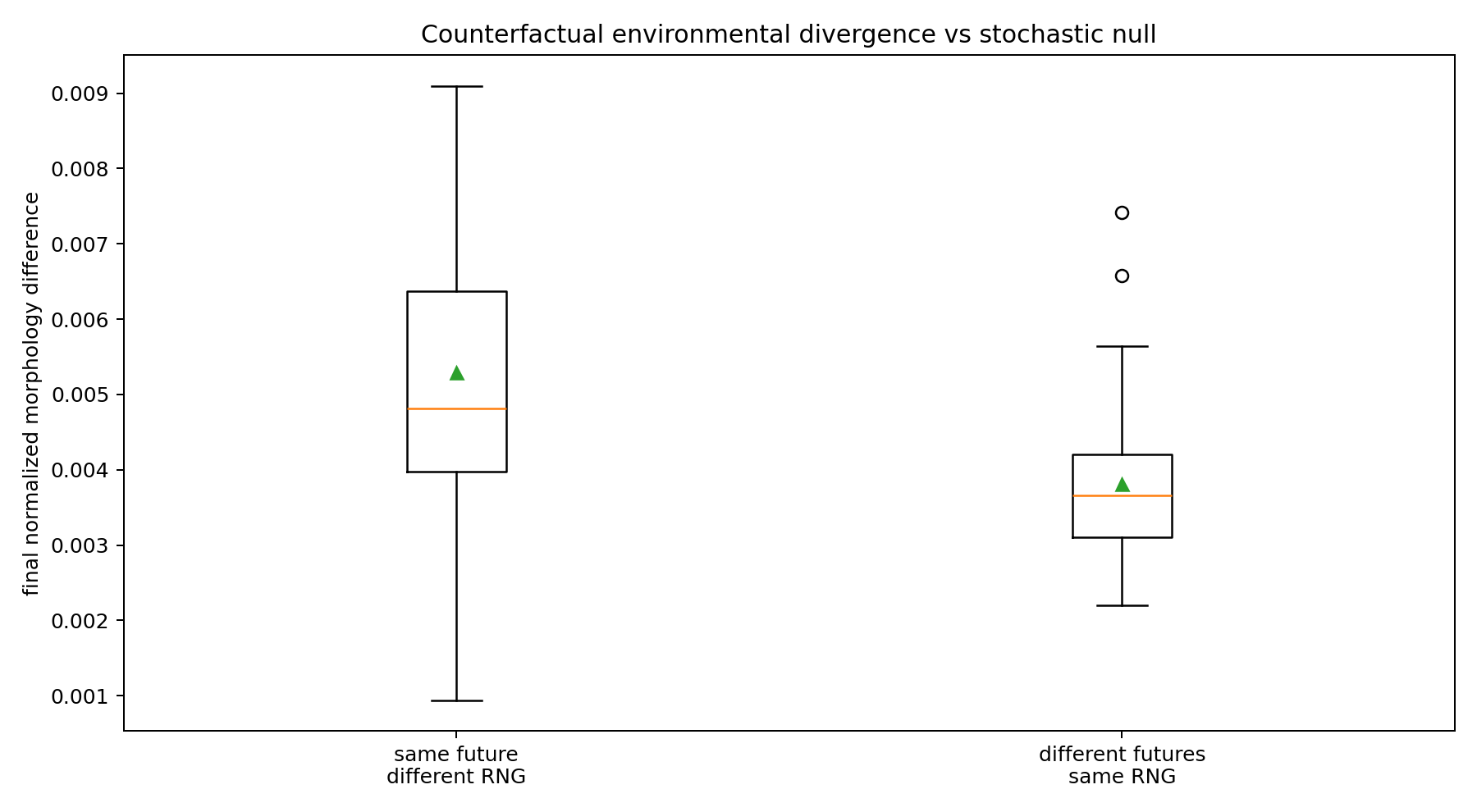
Changing future forcing produces alternative futures, but the resulting divergence is not larger than ordinary stochastic continuation divergence under this experiment.
This kills a stronger interpretation.
We cannot say:
Environmental differences dominate future divergence.
They did not.
In fact, under this protocol ordinary stochastic variation produced somewhat greater divergence on average.
That leaves a smaller, cleaner result:
The checkpoint is an executable branch point, but branchability does not imply that one chosen environmental manipulation dominates the system’s intrinsic stochastic variation.
That is exactly why the null matters.
This Is Not Reproduction
We should resist that word.
We can restore the same checkpoint many times.
That resembles copying.
But the copying is performed by our experimental infrastructure.
Nothing here establishes autonomous reproduction.
The useful property is narrower:
Digital state can be duplicated as an exact starting condition for controlled counterfactual experiments.
That is already powerful enough.
The Crystal Now Has a Recoverable Past
Chapter 14 ended with:
PRESENT MORPHOLOGY
→ SOME SOURCE INFORMATION SURVIVES

TEMPORAL ORDER
→ NOT RECOVERABLE
We did not solve that by forcing more temporal information into morphology.
We introduced a separate historical mechanism.
Now we have:
CURRENT PROCESS STATE
+
EVENT HISTORY
which provides two complementary capabilities:
STATE
→ CONTINUE

HISTORY
→ RECONSTRUCT
Together:
PAST
↓
PRESENT
↓
POSSIBLE FUTURES
But those arrows mean different things.
The past can be reconstructed.
The present can be resumed.
The future can be branched.
That is something Digital Crystal v1 did not possess in Chapter 14.
A Past Without Memory
It is tempting to call this memory.
I do not think we have earned that yet.
We have built:
storage
checkpointing
history
replay
restore
branching
But the crystal itself does not inspect the record.
It does not ask:
What happened before?
It does not change its behavior because of an earlier event stored in the log.
The history exists.
The process does not yet consult it.
So for now:
The Digital Crystal has a recoverable past.
Not memory.
Not learning.
A past.
That is enough.
What Survived the Hypothesis?
The chapter began with a simple problem:
the crystal has a present
but
the present does not preserve chronology
Chapter 14 had already shown that final morphology contains some information about the conditions under which the crystal formed, but not enough to reconstruct temporal ordering.
Chapter 15 asked a different question:
What information must survive if the process is to continue exactly, and what information must survive if its formation history is to be reconstructed?
The answer turned out to contain two distinct mechanisms.
The checkpoint phenomenon
A complete checkpoint can be serialized, restored and continued exactly.
Across the validation runs:
30 / 30 exact restores
The restored process reproduced:
the same cells
the same attachment decisions
the same population trajectory
the same final process state
But visible morphology alone was not sufficient.
The same occupied structure could lead to a different future when hidden continuation variables differed.
So:
VISIBLE FORM
≠
EXECUTABLE STATE
This is not merely an implementation lesson.
It tells us that the future of the Digital Crystal depends on information that is not necessarily visible in the current morphology.
Phenomenon record
Phenomenon: Executable hidden state
Status: SUPPORTED
Current bounded description:
Digital Crystal v1 requires continuation-relevant state beyond visible morphology for exact future replay. A complete checkpoint is sufficient for exact continuation, while morphology alone is not.
The experimentally identified continuation-relevant components include:
occupied structure
RNG continuation state
environmental sequence position
while birth-time metadata behaves differently:
birth time
→ historical information

birth time
→ not required for same occupied-set continuation
That gives us another important distinction:
HISTORICAL INFORMATION
≠
CAUSALLY ACTIVE CONTINUATION STATE
State and history are different computational objects
The event-log experiment exposes the other half of the chapter.
The stored history reconstructs:
96 / 96 morphology states exactly
but that event history does not restore the historical RNG state required for exact stochastic continuation.
So the two representations answer different questions:
CHECKPOINT
→ what is required to continue from here?

EVENT HISTORY
→ how did the present morphology arise?
or more compactly:
STATE
→ FUTURE

HISTORY
→ PAST
They overlap, but they are not interchangeable.
This gives us a second project-wide distinction:
A process can preserve enough information to reconstruct its past without preserving the continuation state required to regenerate its exact future from that reconstruction alone.
The implementation failure revealed a deeper rule
The accidental dependence on Python set iteration order matters here too.
Before canonicalization, the simulation contained an undeclared continuation variable:
Python container traversal order
Two mathematically equivalent reconstructed states could consume the same random draws in different orders and diverge.
That was not Digital Crystal physics.
It was implementation state leaking into the experiment.
Once frontier traversal was canonicalized, exact restore became reproducible.
This gives us a methodological phenomenon worth carrying across the project:
Scientific state must be separated from implementation state.
If hidden program details influence outcomes, they must either be promoted into the declared model or eliminated.
Connection to the Lossy-History Principle
Chapter 15 also sharpens the result from Chapter 14.
Chapter 14 showed:
coarse source characteristics
survive in morphology

exact temporal order
does not
Chapter 15 shows that this loss is not inevitable to the digital substrate as a whole.
The chronology can be preserved perfectly if we use an explicit event history.
So the stronger cross-chapter picture becomes:
MORPHOLOGY
→ lossy historical integration

EVENT LOG
→ exact formation-history reconstruction

CHECKPOINT
→ exact continuation
That matters because it tells us that different representations preserve different slices of the past.
The substrate gives us several native computational affordances:
serialization
checkpointing
event logging
replay
branching
We do not need to force all historical information into visible form.
Counterfactual branchability survives, dominance does not
The checkpoint also provides an executable branch point.
One exact saved state can be restored into multiple controlled futures.
That property survives.
But the stronger environmental-divergence interpretation does not.
Different prescribed future environments produced measurable divergence, yet that divergence did not exceed ordinary stochastic continuation variation under the frozen comparison.
So:
EXECUTABLE BRANCHABILITY
SUPPORTED

ENVIRONMENTAL MANIPULATION
DOMINATES STOCHASTIC DIVERGENCE
NOT SUPPORTED
Again, the failed interpretation does not erase the underlying capability.
What this phenomenon does not establish
The surviving phenomena do not establish:
- cognitive memory,
- learning,
- adaptation,
- autonomous reproduction,
- a mathematically minimal state representation,
- a biological genome analogue,
- or life.
They establish something narrower and more computationally native:
A Digital Crystal can possess hidden executable state sufficient for exact continuation, an explicit history sufficient for exact morphology reconstruction, and a checkpoint that functions as a reusable counterfactual branch point. These are distinct capabilities carried by distinct representations.
This phenomenon should now be tracked independently of the chapter’s stronger historical or environmental interpretations.
Evidence Ledger
| Claim | Status | Evidence |
|---|---|---|
| Canonicalized model survives state serialization/reconstruction | SUPPORTED | one-step and 48-step invariant pass |
| Complete checkpoint resumes exact trajectory | SUPPORTED | identical process and morphology hashes |
| Exact restore generalizes across tested seeds | SUPPORTED | 30/30 exact |
| Visible morphology alone is sufficient continuation state | FAILED | 30-cell divergence |
| RNG state matters for exact continuation | SUPPORTED | 28-cell divergence |
| Signal cursor matters at fixed horizon | SUPPORTED | 27-cell divergence |
| Birth-time metadata affects future occupied-set growth | FAILED | 0 differing occupied cells |
| Birth times function as historical metadata in v1 | SUPPORTED | history differs while geometric continuation does not |
| Event log reconstructs morphology trajectory | SUPPORTED | 96/96 trajectory hashes |
| Event log reconstructs historical RNG state | NOT SUPPORTED | additions alone do not contain RNG history |
| State and history are operationally distinct | SUPPORTED | one continues; one reconstructs |
| Checkpoint is an executable branch point | SUPPORTED | controlled alternative continuations |
| Different forcing produces divergence beyond stochastic variation | NOT SUPPORTED | treatment mean < stochastic-null mean |
| Checkpoint representation is mathematically minimal | UNTESTED | only sufficiency/ablations tested |
| Stored history is cognitive memory | NOT CLAIMED | process does not consult history |
| Crystal learns or adapts from history | NOT CLAIMED | no such mechanism |
| Crystal is alive | NOT CLAIMED | evidence insufficient |
Bounded Claims
From this chapter we can reasonably claim:
-
Exact continuation — A complete Digital Crystal v1 checkpoint can be serialized, restored and continued without altering the stochastic trajectory.
-
Reproducibility across runs — Exact restore succeeded in
30/30independent validation runs. -
Morphology is not complete state — Identical visible structure can produce a different future if relevant hidden continuation variables differ.
-
RNG state matters — Stochastic continuation state affects exact future growth.
-
Environmental position matters — Signal position affects exact continuation even when the number of future updates is held fixed.
-
Birth time is history, not growth state in v1 — Changing birth metadata alone does not alter the future occupied-cell trajectory.
-
History can reconstruct morphology — The explicit event log reconstructs the recorded formation trajectory exactly across
96/96states. -
State and history are operationally distinct — The checkpoint supports continuation; the event log supports reconstruction.
-
A checkpoint is an executable counterfactual branch point — One saved state can be reused to generate controlled alternative continuations.
-
Environmental branching did not exceed stochastic divergence — Under the tested protocol, changing future forcing did not produce more divergence than ordinary stochastic continuation variation.
That is where the evidence stops.
Something Else Has Happened
There is one more consequence.
Our history is made from events.
Until now those events stay inside the experimental record.
CRYSTAL
↓
EVENT
↓
HISTORY
But an event does not have to remain internal.
One process can emit one.
Another process can receive it.
The event does not need to contain language.
It does not need semantics.
It may contain almost nothing.
one bit
a pulse
a number
And if one process can change the conditions experienced by another, then the environment no longer needs to come entirely from outside the system.
Something generated inside one process can become part of another process’s world.
CRYSTAL A
↓
EVENT
↓
CRYSTAL B
But Chapter 13 taught us to be careful with correlation.
Chapter 14 taught us that state is not history.
And this chapter taught us that a branch can diverge without the environment being the dominant cause.
So we should not call the next thing communication merely because we connect two systems.
The next question has to be smaller:
Can an event emitted by one Digital Crystal reliably change another?
The crystal has a past.
Next, we let the crystals hear each other.
