Time Dilation and Length Contraction
Two routinely misquoted effects stated precisely with hidden conditions explicit: symmetric clock-slowing at three-fifths light speed and what slow actually compares.
“Moving clocks run slow.” Let frame $S'$ move at $v=3/5$ relative to $S$.
- Clock $C'$ rests in $S'$. Its reading $\tau=4$ happens at $S$-coordinates $(t,x)=(5,3)$. So $S$ sees $C'$ advance $4$ while its own time advances $5$: $C'$ is slow in $S$.
- Clock $C$ rests in $S$ at $x=0$. Its reading $4$ happens at $S'$-coordinates $(5,-3)$. So $S'$ sees $C$ advance $4$ while its own time advances $5$: $C$ is slow in $S'$.
(Executed.) Each frame says the other’s clock is slow. If that were a contradiction, relativity would be inconsistent. It is not. The two observations compare different pairs of events, and “slow” has a meaning only once you say which pair. This chapter is about saying which.
It gives precise statements of two effects that are routinely misquoted, time dilation and length contraction, with each hidden condition made explicit. It builds on the boost (Chapter 19), the interval (Chapter 20) and the frame vocabulary (Chapter 17).
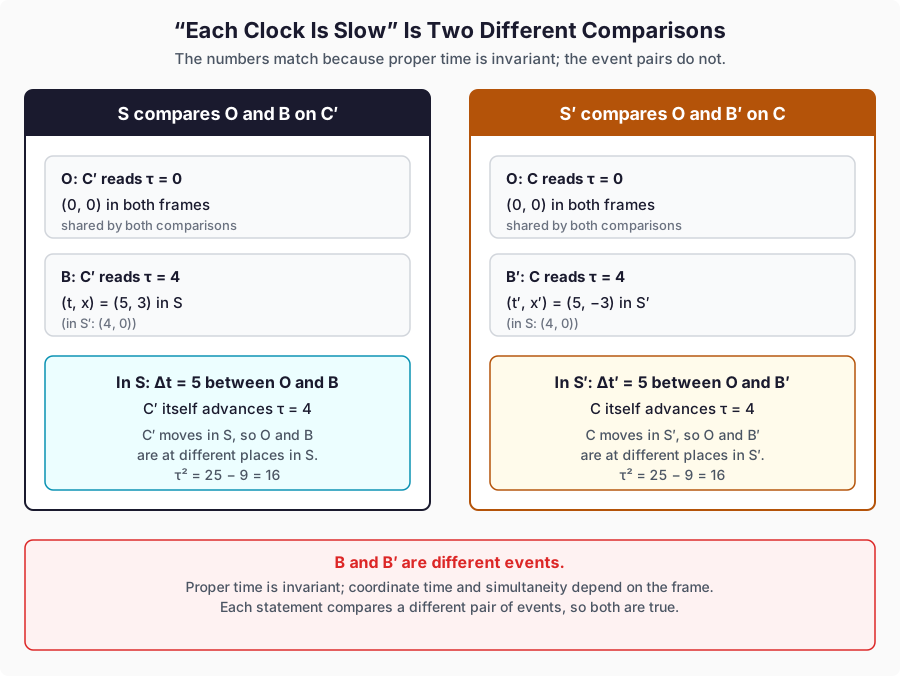
The two-clock comparison. Each frame uses its own simultaneity convention and therefore its own pair of events; proper time is the invariant number, not the coordinate time.
The statements, with their hidden conditions
No claim is qualified here. These are candidate statements, each with its hidden conditions written out:
| Candidate | Statement | Hidden conditions |
|---|---|---|
| Time dilation | If two events occur at the same place in $S'$ ($\Delta x'=0$), then $\Delta t = \gamma\,\Delta t'$ | The clock is at rest in $S'$; $\Delta t$ is measured in $S$ as the difference of the two events’ $S$-times, which are not simultaneous in $S$ |
| Length contraction | If the ends of a rod are located at the same $S$-time ($\Delta t=0$), then the $S'$ separation is $\gamma\,\Delta x$; for a rod at rest in $S'$, $\Delta x = L_0/\gamma$ | The ends are marked simultaneously in the measuring frame |
Lemma box: domain and sign conditions. The proper-time formula uses a timelike separation $\Delta t^2 - \Delta x^2 > 0$ and a future-directed pair of events; the square root is the nonnegative proper time. Time dilation uses a clock at rest in $S'$ ($\Delta x'=0$) and $\gamma>0$. Length contraction uses end events that are simultaneous in the measuring frame. These are hypotheses of the informal derivation, not new evidence, and the Lean examples below remain illustrative rather than versioned claims.
Proper time: the number every frame agrees on
For two events on the worldline of one clock, the interval is positive. Take the clock’s two events with $\Delta x'=0$. Computed in the clock’s own frame, the interval is $\Delta t'^2 - 0 = \Delta t'^2$. Interval invariance (Chapter 20) says the same number appears in $S$:
Time dilation is about one pair of events
With $\Delta x'=0$, the inverse boost gives $\Delta t = \gamma\,\Delta t'$. This is
Lean-checked (boostInverseTime, timeDilation). timeDilation assumes
$\gamma^2(1-v^2)=1$ and $\gamma(\Delta x - v\,\Delta t) = 0$, that is,
$\Delta x'=0$, and concludes $\Delta t = \gamma\bigl(\gamma(\Delta t - v\,\Delta x)\bigr)$,
that is, $\Delta t = \gamma\,\Delta t'$. For the example, $5 = \tfrac54\cdot4$.
The factor $\gamma$ is at least $1$, so $\Delta t \ge \Delta t'$: the time measured in the frame where the two events are not at the same place is longer. Time dilation is a statement about a pair of events that share a location in one frame.
Length contraction is about simultaneity
A rod’s length in a frame is the distance between its two ends at the same time in that frame. In $S$, take both ends at $t=0$. The $S'$ coordinate of an event is $x' = \gamma(x - vt)$, so at $t=0$, $\Delta x' = \gamma\,\Delta x$. A rod at rest in $S'$ has $\Delta x' = L_0$, so $S$ measures $\Delta x = L_0/\gamma$. In the example, $L_0=5$ gives $\Delta x = 5/(5/4) = 4$ (executed).
This is Lean-checked as well (lengthContraction), though the theorem is a
one-line ring identity. All of the content is in setting up simultaneity
correctly, not in the algebra.
Where the symmetry goes
Apply the same reasoning from $S'$’s side. A clock at rest in $S$ reads $\tau=4$ between events that $S'$ assigns $(\Delta t', \Delta x') = (5,-3)$. By proper time, $25 - 9 = 16$ again. The two statements, “$S$ sees $C'$ slow” and “$S'$ sees $C$ slow”, each concern a pair of events at the same place in a different frame. They are the same theorem applied twice, with the roles exchanged. They do not conflict.
The famous “twin paradox”, in which one twin turns around, is a question about a closed comparison of two worldlines. It needs an acceleration phase, and so an extension beyond this chapter’s inertial statements. It is not covered here.
What this establishes
The interval invariance behind the proper-time argument is qualified (Chapter 20). The exact-rational instances and the Lean theorems above are illustrative; none is an engine claim, so none appears in the evidence tables of earlier chapters. The derivation is short enough for a reader to redo with the inverse boost; no review is recorded.
These are statements about coordinates in the mathematical model. The empirical claim, that real moving clocks slow down by the Lorentz factor, is a different claim. It needs experimental sources and the empirical milestone (MATH06), which has not started. A prediction and an observation can be compared only once both are written down as versioned claims with an uncertainty model, which the old outline planned for a later chapter (its Ch. 34) not in this edition.
The chapter is designed to block three common misreadings:
- “Time dilation is an illusion of measurement.” It is a statement about coordinates, and proper time is invariant and real in the model.
- “Length contraction shrinks the rod.” A rod’s rest length is unchanged. A different quantity, which depends on the frame (the separation of simultaneous end events), is smaller.
- “Each frame sees the other’s clock slow, so it’s a paradox.” See above.
Try it yourself
uv run python content/examples/math/part3/part3_kinematics_demo.py
cd formal/lean && lake env lean ../../content/examples/math/part3/part3_lean_demo.lean
The “Ch 21” section of
part3_kinematics_demo.py
prints $(5,3)$ with interval $16$, the rod length $4$, and the $S'$ coordinates
$(5,-3)$ of the $S$ clock. The Lean file
prints one #print axioms line per theorem.
Seeded errors. In timeDilation, drop the hypothesis hsame. The statement
becomes false (take $\Delta x \neq v\,\Delta t$), and the proof cannot go through.
In the demo, change tau = 4 to tau = 3; the rod and symmetry numbers are
unaffected, but the interval printed in the clock line changes to 9.
Exercises.
- A clock at rest in $S'$ ticks once between $t'=0$ and $t'=12$. With $v=5/13$ ($\gamma = 13/12$), what are $\Delta t$ and $\Delta x$ in $S$, and what is the proper time? (Answer: $\Delta t = 13$, $\Delta x = v\,\Delta t = 5$, and $\tau = \sqrt{169-25} = 12$.)
- A rod of rest length $13$ lies in $S'$. How long is it in $S$ at $v=5/13$? (Answer: $13/(13/12) = 12$.)
Open questions.
- Is the proper-time argument stated with enough care about which interval is meant? A formal version should say “timelike separation, future-directed” explicitly; Chapter 22 supplies that language.
- Is
lengthContractiontoo trivial to be worth a theorem? A better formal statement would build the simultaneity condition into hypotheses on pairs of events, not on coordinate differences. - Which experiment would the book cite for time dilation, and what is the right status for a claim of empirical support based on it?
Sources
For textbook and experimental context only; the chapter makes no empirical claim, and these have not been read closely for this edition:
- Edwin F. Taylor and John Archibald Wheeler, Spacetime Physics: Introduction to Special Relativity (W. H. Freeman, 1992)
- Bruno Rossi and David B. Hall, “Variation of the Rate of Decay of Mesotrons with Momentum”, Physical Review (1941), https://doi.org/10.1103/PhysRev.59.223
- J. Bailey et al., “Measurements of Relativistic Time Dilatation for Positive and Negative Muons in a Circular Orbit”, Nature (1977), https://doi.org/10.1038/268301a0
No repository source covers this chapter.