Velocity, Light Cones, and Causality
Timelike, lightlike, and spacelike separation; velocity composition keeping speeds below light; and why time order survives boosts for exactly one kind.
Can a boost ever make an effect come before its cause? Take two events with $\Delta t=1$ and $\Delta x=2$, and boost by $v=3/5$ ($\gamma=5/4$). Executed:
The interval sorts pairs of events into three kinds; time order survives boosts for some kinds and not others; and boosts compose by a law that keeps speeds below $1$. The chapter builds on the interval (Chapter 20) and the boost (Chapter 19).
Three kinds of separation
For two events separated by $(\Delta t, \Delta x)$, the interval $s = \Delta t^2 - \Delta x^2$ has a sign that every frame agrees on (Chapter 20):
| Sign of $s$ | Name | Meaning |
|---|---|---|
| $s>0$ | timelike | A signal slower than light could connect them |
| $s=0$ | null (lightlike) | Only light could connect them |
| $s<0$ | spacelike | No signal at or below light speed could connect them |
Executed, for $v=3/5$:
timelike  (2, 1)  interval  3 -> (7/4, -1/4)  interval  3
spacelike (1, 2)  interval -3 -> (-1/4, 7/4)  interval -3
null      (1, 1)  interval  0 -> (1/2, 1/2)   interval  0
The interval is unchanged, so its sign is too. A null separation stays null, with a different (here halved) time and distance. The light cone through an event, the set of events at null separation from it, is the same set in every frame.
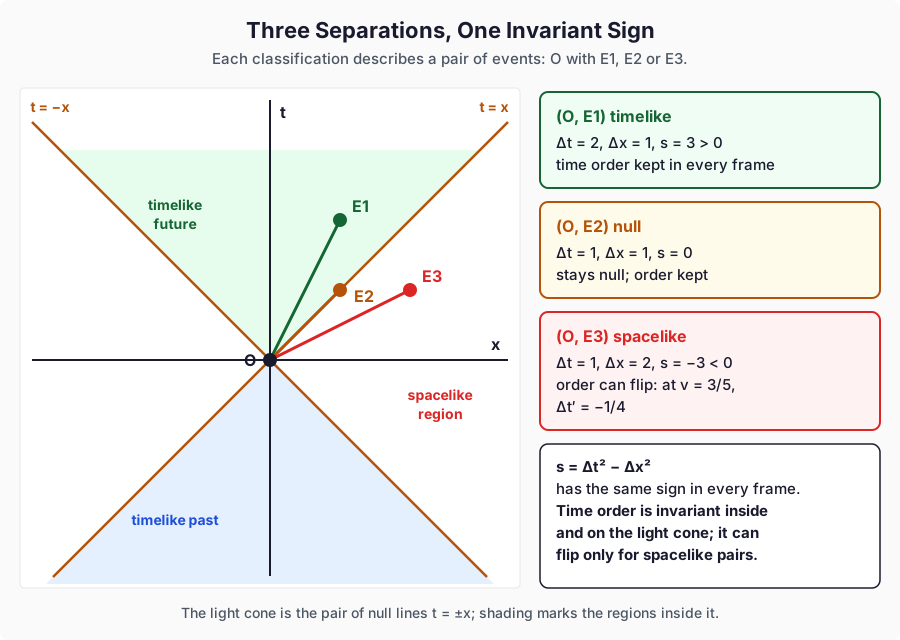
Three separations. The interval sign is invariant; time order is invariant inside and on the light cone and can flip only for spacelike pairs.
Time order: kept for timelike pairs, not for spacelike ones
Theorem (illustrative). If $\lvert v\rvert<1$ and $\lvert x\rvert< t$ (future timelike), then $t - vx > 0$, so $t'$ has the sign of $t$ and the order is preserved.
Lemma box: hypotheses and encoding. The theorem assumes $\lvert v\rvert<1$ and $\lvert x\rvert< t$, equivalently $t>0$ and $t^2-x^2>0$ for the future-directed branch. The velocity-composition formula below also requires $\lvert v_1\rvert<1$, $\lvert v_2\rvert<1$ and $1+v_1v_2\neq0$; the last condition follows from the bounds, but it is a condition on a real denominator, not an extra physical premise. The Lean statement uses $\lvert v\rvert<1$ directly; the Z3 encoding adds $\gamma>0$ and $\gamma^2(1-v^2)=1$. They are therefore different propositions and must not be reported as one cross-system result.
Proof. Write $t - vx = \tfrac12\bigl[(1-v)(t+x) + (1+v)(t-x)\bigr]$. Each term is a product of positive factors, since $\lvert v\rvert<1$ and $\lvert x\rvert< t$. $\square$
This is Lean-checked (timelikeOrderPreserved, via abs_lt and nlinarith). In
Z3, the negation ($\gamma>0$, $\gamma^2(1-v^2)=1$, $\lvert v\rvert<1$, $t>0$,
$t^2-x^2>0$, $\gamma(t-vx)\le0$) is unsat (executed). Two tools agree on their
encoded statements, but as Chapter 6 explains, that agreement is
not the argument. The three-line proof is.
Counter-statement (illustrative). For a spacelike separation the order can
flip. This is Lean-checked (spacelikeOrderCanFlip) with the explicit witness
$t=1$, $x=3$, $v=1/2$, where $t - vx = 1 - 3/2 < 0$. Asked to satisfy the same
hypotheses with $x^2>t^2$, Z3 returns sat with the model $x=3$, $t=1$, $v=1/2$
(executed). This is a witness to an existential statement, validated by
substitution, as in Chapter 5.
Velocity composition
If $S''$ moves at $v_2$ relative to $S'$, which moves at $v_1$ relative to $S$, the composed velocity is
3/5 ⊕ 3/5 = 15/17 1 ⊕ 3/5 = 1 4/5 ⊕ 4/5 = 40/41
All three stay at or below $1$, and composing light speed with anything gives light speed. In the Doppler-factor language of Chapter 19, composition is multiplication: $k(v_1\oplus v_2) = k(v_1)\,k(v_2)$. For $3/5 \oplus 3/5$, $k = 2\cdot2 = 4$ and $v = (16-1)/(16+1) = 15/17$. The two routes agree.
Lean checks (velocityAdditionSubluminal) that $\lvert v_1\rvert<1$ and
$\lvert v_2\rvert<1$ imply $\lvert(v_1+v_2)/(1+v_1v_2)\rvert<1$. What is not
checked is that this formula is the composition of two boosts. The theorem says
only that the result is slower than light. Identifying it with boost composition
is a paper argument here, via the multiplicativity of $k$.
Causality, carefully
“Causality is preserved” is shorthand for three linked statements:
- Mathematical: the time order of any two timelike- or null-separated events is the same in every inertial frame (the theorem above, for the timelike case).
- Physical premise: causes influence effects only through signals that travel no faster than light, so a cause and its effect are timelike or null separated.
- Conclusion: no inertial observer sees an effect before its cause.
The engine can speak to (1) and nothing else. Premise (2) is empirical and part of the model; the Lorentz transformation does not imply it. In this model, a theory with faster signals would produce causal paradoxes. What that shows about such a theory is a question for interpretation, not a status the engine assigns.
What this establishes
| Candidate | Statement | Standing |
|---|---|---|
| Timelike order preserved | $\lvert v\rvert<1$, $\lvert x\rvert< t$ implies $0 < t-vx$ | Lean-checked, Z3 unsat of negation (illustrative) |
| Spacelike order can flip | There exist $t, x, v$ with $\lvert v\rvert<1$, $t>0$, $t^2< x^2$, $t-vx<0$ | Lean-checked, Z3 sat (illustrative) |
| Velocity addition stays subluminal | $\lvert v_1\rvert,\lvert v_2\rvert<1$ implies $\lvert(v_1+v_2)/(1+v_1v_2)\rvert<1$ | Lean-checked (illustrative) |
| Velocity addition is boost composition | The formula composes boosts | Paper argument only |
Only interval invariance is qualified (Chapter 20); everything else here is illustrative, at the level shown in the table. The timelike-order proof is a short positivity argument that is easy to check; no review is recorded.
Lean and Z3 address the timelike-order statement with different encodings: Lean over $\lvert v\rvert<1$ directly, Z3 over $\gamma$ with $\gamma^2(1-v^2)=1$ and an explicit $\gamma>0$. The Z3 version carries an extra hypothesis, so the two are not the same proposition. On the ladder of Chapter 15 this is L0 at best, and neither has a claim contract.
So, about the model, this chapter establishes that the light cone is a structure every frame agrees on, that timelike order is invariant, and that spacelike order is not. It does not establish that nothing travels faster than light. That is a physical premise the model builds in, and the engine has no experiment behind it.
Try it yourself
uv run python content/examples/math/part3/part3_kinematics_demo.py
cd formal/lean && lake env lean ../../content/examples/math/part3/part3_lean_demo.lean
(Download the Python script or the Lean file.)
Boundary check. Executed on 2026-11-09 with Z3 5.3.1, using
ch05_10_18_22_24_checks.py:
weaken $\lvert x\rvert< t$ to $\lvert x\rvert\le t$ in timelikeOrderPreserved.
With $t>0$, the negation of $t-vx>0$ is still unsat under $\lvert v\rvert<1$, so
the statement extends to null separations.
Seeded error. In that weakened ($\lvert x\rvert\le t$) version, also weaken
$\lvert v\rvert<1$ to $\lvert v\rvert\le1$. The negation becomes sat, with the
model $x=-1$, $t=1$, $v=-1$: a null pair seen from a “frame” moving at light speed,
where $t-vx=0$ and the strict conclusion fails. (With $\lvert x\rvert< t$ kept
strict, the same weakening of $v$ leaves the negation unsat.)
Exercises.
- Take the spacelike pair $(\Delta t, \Delta x) = (1,2)$. For which $v$ in $(-1,1)$ does the time order flip? (Answer: $\Delta t' < 0$ exactly when $1 - 2v < 0$, that is, $v > 1/2$.)
- Check $4/5 \oplus 4/5 = 40/41$ using Doppler factors. (Answer: $k(4/5) = 3$, so the product is $9$ and $v = (81-1)/(81+1) = 40/41$.)
Open questions.
- The Z3 encoding assumes $\gamma>0$ explicitly, while the algebraic theorem does not. Should timelike order be stated for $\gamma$ of either sign, with $\gamma<0$ meaning a time-reversing boost?
- How would the engine express premise (2), the bound on signal speeds, as a claim an experiment could challenge?
- Proving that velocity addition is boost composition needs a statement about composing two boost functions. Is that best done in Lean with explicit matrices (as Physlib does for the Lorentz group), or in the $k$ parameterization?
Sources
- Edwin F. Taylor and John Archibald Wheeler, Spacetime Physics: Introduction to Special Relativity (W. H. Freeman, 1992), for the standard treatment of light cones and causality; not read closely for this edition.
Experimental bounds on signal speeds are not yet cited. No repository source covers this chapter.