Privacy, GDPR, and AI Regulation
Which personal-data and regulatory obligations follow data through a distillation pipeline? Lawful bases, minimisation, erasure across stores and derived artefacts, the AI Act's consolidated timetable, and a deterministic E4 privacy audit.
Chapter 37 asked who may copy. This chapter asks who may be identified — because personal data, once inside a pipeline, follows every artifact downstream, and no copyright permission establishes a data-protection basis:
How should personal-data rights, privacy obligations and AI regulatory requirements influence a distillation system’s design, especially when demonstrations, memory and model weights may retain information?
The answer separates three duties that share a pipeline but not a logic: data protection for people, documentation for systems, and deletion that must reach every copy including the copies that cannot be deleted. This chapter is educational, not legal advice. It states texts with versions and dates, marks interpretation, and escalates everything structural. Nothing here certifies compliance.
Personal data from first principles
Personal data is information relating to an identified or identifiable living individual — names, addresses, and identifiers, but also trajectories, prompts, and outputs from which a person can be singled out, including by combination with other data. The test is identifiability, not sensitivity and not format: integer entity codes in a synthetic lookup table are not personal data because no living individual stands behind entity 3, while a rare-disease case narrative with names removed can remain personal data because the pattern identifies. Publicly accessible personal information remains personal data subject to data protection law — the Irish Data Protection Commission’s standing warning, and the reason this book never treats public availability as a training licence.
Prompts carry people (user-provided details, third parties named in requests), trajectories carry them further (tool results, retrieved records, file contents accumulated across steps), and outputs can carry them out (memorised addresses, inferred attributes). Memory systems concentrate the problem: a store that accumulates facts across episodes becomes a personal-data register the moment any fact relates to an identifiable person, with retention and erasure duties attaching to the store, its backups, and every model distilled from it. The book’s E4 environment holds integer codes by construction — audited below — so this section teaches the shape of the duty on material designed to be empty of it.
Roles, bases, and limits
The controller determines purposes and means; the processor acts on instructions. A distillation programme is typically the controller of its teaching data and remains responsible through contractors, APIs, and hosting — processor contracts (Article 28) must record subject matter, duration, nature, purposes, and duties including deletion at the end of provision. The DPC publishes a practical guide to controller-processor contracts (verified 16 November 2026); the guide is help, not law.
Processing needs a lawful basis (Article 6, L-021): consent, contract, legal obligation, vital interests, public task, or legitimate interests. Consent is one basis among six, and a poor default for training corpora — it must be freely given, specific, informed, unambiguous, and as easily withdrawn as given, which web scale rarely survives. The DPC’s AI supervision reporting highlights legitimate interests as a basis for AI training (L-025; guidance, not a safe harbour), balanced against data-subject rights with transparency and minimisation doing heavy lifting. No basis in this chapter is declared for any real processing; the book processes no personal data at all.
Purpose limitation binds collection to specified, explicit, legitimate purposes — data mined for benchmarking may not drift into user profiling. The drift scenario is worth one concrete paragraph because pipelines drift by default: a trajectory corpus collected to measure tool-use success is later reused to profile operator skill, or a support-dialogue set kept for regression testing is mined for sentiment signals about callers.
Each reuse is new processing needing its own basis, its own minimisation review, and its own retention clock; “we already had the data” is not a basis. The audit enforces this by binding every inventory item to a purpose string and failing any item whose use outgrows it — a software check on a legal boundary, with the lawyer deciding the boundary.
Article 30 reads like a manifest
There is a productive resemblance hiding in the compliance apparatus: an Article 30 record of processing lists purposes, categories of data and data subjects, recipients, transfers, retention periods, and security measures — very nearly the provenance manifest this book already keeps for synthetic data (names, templates, tokenizers, seeds, fingerprints, rights records, retention notes), kept to the dataset-datasheet and model-card documentation practice (Gebru et al.; Mitchell et al.). The resemblance is deliberate convergence, not equivalence: manifests prove what the pipeline did, Article 30 records declare what the law requires, and the gap between them is exactly the review surface.
Programmes that keep manifests as engineering hygiene inherit half of Article 30 for free; the other half — subjects, transfers, erasure handling — is where synthetic-only programmes stay silent and personal-data programmes must speak. Chapter 39’s audit report carries both halves in one schema so the silence, where it persists, is itemised rather than invisible. Minimisation requires adequacy, relevance, and no more than necessary: the DPC’s guidance pages on principles and on anonymisation versus pseudonymisation (verified 16 November 2026) make the operational point that narrower corpora are easier to defend.
Storage limitation sets the clock: the E4 inventory below carries retained-until dates, and expiry must trigger deletion or re-justification, not silent retention. Accuracy, integrity, confidentiality, and security (Article 32) demand appropriate technical and organisational measures — the DPC’s data-security guidance for controllers and its security recommendations are the operational starting point, not the ceiling. Transparency (Articles 12–14) requires telling people what happens to their data in intelligible form; a privacy policy describes practice, it is not consent and not a basis.
Special-category data (Article 9, L-021) — racial or ethnic origin, political opinions, religious or philosophical beliefs, trade union membership, genetic and biometric data, health, sex life, sexual orientation — faces a general prohibition lifted only by narrow conditions. Voice recordings and images of people are biometric-adjacent by default: any pipeline touching voice, face, or health-adjacent signals must flag special-category review before collection, with the flag in the record and a specialist attached. The book’s required biometric example is therefore a refusal template: no voice, no faces, no health signals anywhere in E1–E4, and any proposal to add them restarts the analysis from the Article 9 prohibition, not from convenience.
Pseudonymisation is not anonymisation
Pseudonymised data — identifiers replaced with codes held separately — remains personal data wherever re-identification is reasonably possible; the GDPR applies in full, with the code key under access control and the re-identification risk assessed. Only anonymous data, where no individual is identifiable by any means reasonably likely to be used, falls outside data protection law — and the DPC’s anonymisation guidance stresses how rarely high-dimensional data (trajectories included) clears that bar.
The audit’s negative control pins the failure mode: rows marked “anonymous” that remain linkable hold the release, because the label is a claim requiring proof, and trajectory-shaped data defeats naive de-identification as a matter of routine. Treat pseudonymisation as a safeguard inside the law, never as an exit from it.
Rights, records, and impact assessments
Data subjects hold rights of access, rectification, erasure, restriction, portability, objection, and freedom from solely automated decisions with legal or similarly significant effect (Articles 12–22, with erasure in Article 17, L-021, exercisable in specified circumstances including withdrawn consent and unlawful processing). Honouring them requires records of processing (Article 30, L-021) detailed enough to find the data — the DPC’s Article 30 guidance (verified 16 November 2026) describes the contents — and impact assessments (Article 35, L-021) before high-risk processing, following the DPC’s DPIA guide and its list of processing operations requiring one.
A distillation programme training on personal data is DPIA-shaped by default: novel technology, large scale, potential special categories, and evaluation of individuals. The book’s position is simpler to audit: no personal data, no DPIA trigger, with the screening recorded rather than assumed — and any change of that position triggers the DPIA before collection, not after training. A worked screening for the E4 store, kept on file: purpose (procedural memory demo), data (integer codes, no persons), scale (64 records), novelty (low — exact-match lookup), special categories (none), individual evaluation (none), cross-border transfer (none), result (no DPIA required; re-screen on any data change). The screening is five lines because the facts are simple; the discipline is recording it anyway, so the day the facts change, the missing DPIA is visible instead of merely missing.
What models remember
Training can memorise: Carlini et al. (P-053) demonstrate extracting memorised training examples by querying a model — the register notes the venue year unreconciled, and the chapter uses the provenance principle, not the attack details. A distilled student can therefore carry what its teacher memorised, and filtering prompts does not remove parametric traces. Machine unlearning — approximate removal with guarantees — is an active research area with no settled, auditable standard applicable to this workbench; it is named as the missing rung, not claimed. The operational consequence is the deletion ladder of this chapter’s implementation: store retirement demonstrated, revocation, invalidation, checkpoint retirement, and retraining procedural, parametric-erasure proof NOT VERIFIED.
    flowchart TD
  S[store retirement: demonstrated] --> V[revocation: procedural]
  V --> I[invalidation of derivatives]
  I --> C[checkpoint retirement]
  C --> R[retraining without the data]
  R --> U[unlearning: no settled standard]
  U --> P[parametric erasure: NOT VERIFIED]
Figure 1. The deletion ladder, rung by rung: demonstrated at the top, unverified at the bottom. A retrieval query that returns nothing proves the index, never the weights — the distinction the chapter refuses to let blur, because every unfounded “fully deleted” claim in this industry stands on exactly that confusion.
The AI Act as consolidated
Regulation (EU) 2024/1689 (L-023; in force 1 August 2024) as amended by Regulation (EU) 2026/1744 (L-024; adopted 8 July 2026, in force 27 July 2026) is the applicable text, read in its consolidated version dated 27 July 2026. The register’s standing caveat applies verbatim here: reconcile the current Article 113 dates before stating the timetable as fact, with qualified review. Subject to that caveat, the recorded schedule runs: general-purpose AI obligations from 2 August 2025, transparency obligations (Article 50) from 2 August 2026, Annex III high-risk obligations from 2 December 2027, Annex I high-risk obligations from 2 August 2028.
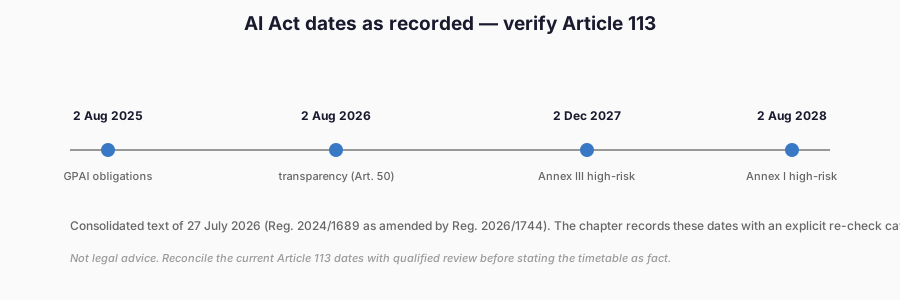
Figure 2. The recorded schedule with its caveat: dates subject to Article 113 reconciliation with qualified review. Recorded 16 Nov 2026; not legal advice.
The role analysis decides which duties bite. Providers placing high-risk systems on the market carry conformity, documentation, logging, and oversight duties. Deployers using them carry use, monitoring, and human-oversight duties proportionate to control. General-purpose AI model providers carry the Article 53 package the register records: technical documentation, downstream information, a copyright policy including Article 4(3) reservations, and a training-content summary — plus systemic-risk duties at the top tier. Research, development, and prototyping before market placement sit under exemptions and transition provisions whose boundaries need facts, not slogans.
The exemptions most often misread are worth naming precisely because they are narrow: research purely for scientific purposes outside any product trajectory is treated differently from development that feeds a release; open-source publication of weights relieves only some duties, not all, and not for systemic-risk models — the exact scope needs the consolidated text; and transition periods delay dates, never duties — the obligation stands, the clock moves. This book’s workbench — synthetic tasks, self-created models, no market placement, no commercial GPAI provision — is not treated as a regulated high-risk system or a commercial GPAI provider in this chapter; that is a reasoned position on stated facts, and the facts that would change it are listed: real personal data, market placement or commercial provision, high-risk use contexts, systemic-risk scale, or downstream deployment. Any one of them re-opens the role analysis from the start.
Transparency duties deserve separate attention because they reach further than high-risk classification: synthetic-content marking and AI-interaction disclosure fall on providers and deployers of the systems Article 50 lists, regardless of risk tier. A distilled agent that acts, answers, or publishes needs its disclosure posture decided before promotion — Chapter 42’s gate, not an afterthought.
Concretely, the provider and deployer must determine: does the system interact directly with individuals (who must be told they deal with AI), does it generate synthetic text, audio, image, or video content (which must be marked as artificially generated in a machine-readable way where the rules require), and does its output inform decisions with legal or similarly significant effects (which triggers the human-oversight and contestability machinery)? Each answer lands in the promotion summary as a provider or deployer duty with an owner — and “the model is small” answers none of them, because the duties attach to use, not to parameter count.
DPC guidance: what was checked
The Irish DPC guidance hub pages (DPIA, anonymisation, legal bases, processor contracts, Article 30, security) were verified on 16 November 2026. The Data Protection Commission guidance hub, including the Guide to Data Protection Impact Assessments, the Anonymisation and pseudonymisation guidance, the Guidance on Legal Bases for Processing Personal Data, A Practical Guide to Controller-Processor Contracts, the Records of Processing (Article 30) Guidance, and Guidance for Controllers on Data Security, was verified on 16 November 2026 page by page — each consulted as guidance with the hub’s own disclaimer that guidance is not legal advice and not binding on the Commission.
The AI Insights Report (L-025; published September 2026) adds supervisory context: legitimate interests in AI training, transparency and minimisation expectations, and early regulatory engagement. None of this is a safe harbour. The chapter uses guidance the way engineers should: as the shape of supervisory expectation, with the binding text (GDPR, AI Act) doing the normative work and counsel resolving the gap between them.
The E4 privacy audit
The full record is planning/38-e4-privacy-audit.md; the method
is the deterministic PrivacyAudit over an explicitly listed
synthetic inventory. Ten audit items, each answered:
- Trajectory inventory — forty synthetic trajectory rows and sixty-four KB facts, all integer-coded, all fictional subjects.
- Source provenance — repository generators and the E4 environment version, recorded per manifest.
- Personal-data classification — NON_PERSONAL throughout, by construction and by field inspection.
- Purpose and lawful-basis fields — recorded per item (“n/a synthetic” is a complete answer for synthetic data; for real data it would be the Article 6 basis, named).
- Retention policy — retained-until dates per item; expiry fails the check by design.
- Deletion requests — synthetic requests exercised against retired keys with log linkage.
- Live versus retired memory — E4-memory manifest: live 60, retired 4, capacity 64, purpose retain-kb-v1.
- Derived artifact references — every derived artifact traces to an inventoried subject in the passing case.
- Missing lineage — untraceable artifacts hold the audit.
- Privacy-review escalation — empty for this inventory; the trigger list stands ready.
Real-record cross-checks (read-only): E4-agent trajectory fingerprints per seed under RM-118; E4-memory store fingerprint and deletion audit under RM-119. No personal-data fields exist in either manifest — verified by inspection, stated as inspection, not as proof of absence elsewhere. The manifests also bound what the audit can say: fingerprints attest that recorded trajectories have not changed, not that unrecorded personal data was never present — which is why the inventory, not the manifest, carries the classification, and why the two are cross-checked rather than substituted.
Deletion, demonstrated and bounded
The E4-memory study established deletion plus read-through success for its bounded store; the audit reuses that result without retraining. The explanatory model extends it rung by rung: deleting an external memory entry (demonstrated), revoking retrieval access (procedural), invalidating derived datasets (procedural), retiring a checkpoint (procedural), retraining without the data (costly but real), machine unlearning (guarantees unsettled), proving parametric erasure (NOT VERIFIED). Six negative controls keep the demonstration honest — missing basis, expired retention, missing log link, surviving live record, surviving derived artifact, false anonymity — each engineered to fail or hold, and each failing or holding as designed. The verdict pattern is the point: a privacy audit that cannot fail is not an audit.
Worked demonstrations (synthetic, labelled)
A teaching set containing personal data. A fictional support dialogue corpus (FICTIONAL subjects, labelled demonstration): classified PERSONAL, lawful basis recorded per row, purpose limited to the study, retention dated, DPIA screened before use. Field-level, the record carries subject pseudonym, turn-level purpose tags (the support request is the purpose; the caller’s employer, mentioned in passing, is out of purpose and redacted or dropped), a minimisation note per column (timestamps coarsened, attachments excluded), and a retention date with an owner. Independently authorised: nothing — each row needs its basis, and the demonstration shows the fields, not a permission.
A pseudonymised dataset that remains personal. The same corpus with names replaced by codes, key held separately: still PERSONAL, still fully governed, re-identification risk assessed and recorded. The anonymity claim is tested and fails open — held for review.
An erasure request reaching a replay buffer. A synthetic subject’s deletion request propagates: live record retired, log entry written, derived checkpoint flagged unaddressed until retired or retrained. The store rung passes; the parametric rung stays NOT VERIFIED, and the report says so on the same page.
A biometric dataset requiring special review. A fictional voice-command corpus: flagged SPECIAL_CATEGORY at intake, Article 9 prohibition noted, processing blocked pending the narrow condition and specialist sign-off. The demonstration ends at the flag — correctly, because the flag is the product.
Decision framework and escalation
For each data item: classify it (with the re-identification test); name the basis or stop; fix purpose and retention dates; record processor terms; screen DPIA and special categories; map deletion across store, log, derivatives, and checkpoints; name the reviewer. Cross-border movement gets its own line in the record because it is routinely forgotten: transfers outside the EEA need an adequacy decision or appropriate safeguards with enforceable rights, and a training pipeline that ships corpora, checkpoints, or logs across borders without that analysis has a hole no domestic basis fills.
The DPC’s transfer guidance (verified via the hub) describes the instruments; the programme records which one it relies on, per transfer, or it does not transfer. Escalate to a qualified specialist: any personal data at all (given this programme’s synthetic posture), any special category, any erasure dispute, any DPIA trigger, any AI Act role doubt, any cross-border transfer, and every redistribution or deployment decision. Consent is never assumed, never the only basis considered, and never inferred from a privacy policy.
Limitations
No personal data processed, so every control is demonstrated on synthetic material — the strongest and weakest fact about this chapter. DPC guidance verified as guidance, not law. AI Act dates subject to the Article 113 caveat; direct EUR-Lex verification failed and is recorded. No case law examined. Carlini et al. used for the provenance principle with the register’s venue caveat. No independent or legal review; this chapter is not legal advice.
Preparing the auditable pipeline
Privacy decides what must be found and forgotten; lineage decides whether the finding and the forgetting can be proved. Chapter 39 builds the graph that links sources, permissions, training, evaluation, and retirement — and reports exactly where the chain breaks.
References
Carlini, N., Tramèr, F., Wallace, E., Jagielski, M., Herbert-Voss, A., Lee, K. et al. (2020). Extracting Training Data from Large Language Models. USENIX Security Symposium. arXiv:2012.07805. https://arxiv.org/abs/2012.07805
Gebru, T., Morgenstern, J., Vecchione, B., Vaughan, J. W., Wallach, H., Daumé III, H. and Crawford, K. (2021). Datasheets for Datasets. Communications of the ACM 64(12). arXiv:1803.09010. https://arxiv.org/abs/1803.09010
Mitchell, M., Wu, S., Zaldivar, A., Barnes, P., Vasserman, L., Hutchinson, B., Spitzer, E., Raji, I. D. and Gebru, T. (2019). Model Cards for Model Reporting. Proceedings of the Conference on Fairness, Accountability, and Transparency (FAT 2019).* https://doi.org/10.1145/3287560.3287596
Legal sources
Regulation (EU) 2016/679 of the European Parliament and of the Council of 27 April 2016 on the protection of natural persons with regard to the processing of personal data (General Data Protection Regulation). Applicable 25 May 2018. https://eur-lex.europa.eu/eli/reg/2016/679/oj (retrieved 12 November 2026). Cited as L-021 for the lawful-basis, minimisation, special-category, and erasure framework; not legal advice.
Regulation (EU) 2024/1689 of the European Parliament and of the Council of 13 June 2024 laying down harmonised rules on artificial intelligence (Artificial Intelligence Act). In force 1 August 2024; general-purpose AI obligations from 2 August 2025. https://eur-lex.europa.eu/eli/reg/2024/1689/oj (retrieved 12 November 2026). Cited as L-023 for the provider, deployer, and general-purpose AI role analysis; consolidated text of 27 July 2026 per L-024; dates subject to the Article 113 caveat; not legal advice.
Regulation (EU) 2026/1744 of the European Parliament and of the Council of 8 July 2026 amending Regulation (EU) 2024/1689 as regards the date of application of certain obligations (Digital Omnibus on AI). In force 27 July 2026. https://eur-lex.europa.eu/eli/reg/2026/1744/oj/eng (retrieved 12 November 2026). Cited as L-024 for the amended application timetable (Annex III from 2 December 2027; Annex I from 2 August 2028); not legal advice.
Irish Data Protection Commission, AI Insights Report. Published September 2026. https://dataprotection.ie/en/dpc-guidance/publications/dpc-AI-insights-report (retrieved 12 November 2026). Cited as L-025 for legitimate interests as a basis for AI training and early engagement; guidance, not a safe harbour; not legal advice.
Irish DPC guidance hub pages (DPIA, anonymisation, legal bases, processor contracts, Article 30, security). Verified 16 November 2026 at https://dataprotection.ie/en/dpc-guidance and consulted as guidance only: the hub disclaims legal advice and binding force. Guides consulted are the DPIA guide, the anonymisation and pseudonymisation guidance, the legal-bases guidance, the controller-processor contracts guide, the Article 30 records guidance, and the controller security guidance; guidance is not legally binding and not legal advice.